The City
I grew up near New York, in the suburbs, close enough that the city was always present but not quite native to me. For a long time I assumed that all major American cities were smaller versions of New York: compressed, vertical, half-glorious and half-decaying, with the elements forced into daily contact by transit, density, and necessity. Only much later did I understand how unusual New York is.
Other cities are more clearly sorted. Dallas, for instance, has Highland Park and Oak Cliff, its zones of money and zones of abandonment, with enough distance between them to soften the shock of their coexistence. One can live in a city like that and rarely encounter the whole. The rich have their routes, the poor have theirs, and the map itself delineates the two.
New York does not permit this quite so easily. It certainly has good neighborhoods and bad neighborhoods, enclaves of wealth and districts of hardship. But its genius (and its burden) is compression. The city folds human conditions on top of one another. The financier, the immigrant delivery worker, the Broadway tourist, the graduate student, the doorman, the homeless addict, the aging rent-controlled widow, the billionaire, the stroller mother, and the man shouting at invisible persecutors are not merely social abstractions to one another; they are near. This nearness is part of what makes New York magnificent. It is also part of what makes it hard to bear.
The chart below began as an attempt to understand that compression. It is not sociology, nor an official classification, but a rough imaginative map of the city’s human layers: income, housing security, rootedness, social capital, exposure, institutional connection, and freedom of movement. The chart arranges a series of archetypes across the city—porous abstractions rather than hard categories—within a vertical structure of lives rising and falling, their proximity creating the peculiar entanglement of New York.
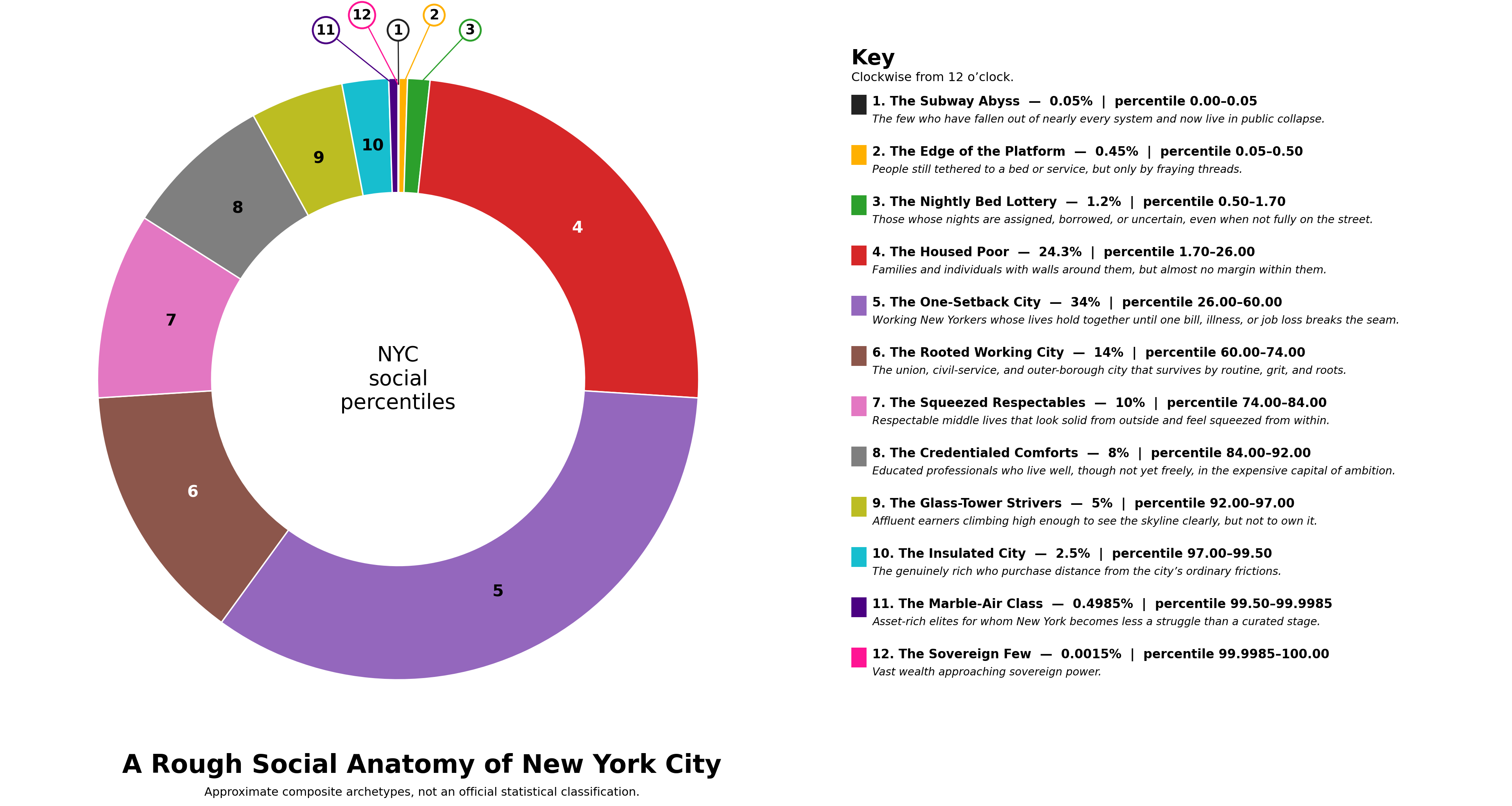
We start with the Subway Abyss: the tiny but highly visible group of people who have fallen out of nearly every ordinary system—family, work, housing, treatment, reputation, schedule, hygiene, law, and trust. These are the people New Yorkers refer to, with a shrug, as “crazy.” The word is revealing, and you will hear it often in conversation. Crazy is not only a diagnosis. It is a civic spell, a way of making disorder intelligible enough to ignore. A man screaming on the train, a woman smoking something bitter in a doorway, a body curled beneath scaffolding, a person unraveling in public—these become “crazy people.” The phrase does not explain them; it contains them. It turns a life into categorized and inevitable part of urban scenery.
There is a practical mercy in the word, perhaps. New Yorkers cannot stop for every instance of suffering. (To live here at all requires a well developed set of filters.) That is, the city throws too much at the eye, too much at the conscience. Without some method of compartmentalization, one would be useless by noon.
But the word also performs a darker function. It removes the phenomenon from the realm of agency, responsibility, and moral demand. If they are simply “crazy,” then no one has to think very hard about how they became so, why they remain so, or why the city has learned to route normal life around their collapse. The individual loses agency, but so does the public. The city itself becomes passive before its own disorder, a type of civic anesthesia.
Just above that lowest layer are other forms of precarity: those near the street but not fully of it; those in shelters; those housed but poor; those working constantly yet living one setback from crisis. Then come the rooted working city, the squeezed middle, the credentialed professional class, the affluent strivers, the insulated rich, and finally the microscopic top, where wealth becomes less a condition of comfort than a form of sovereign power.
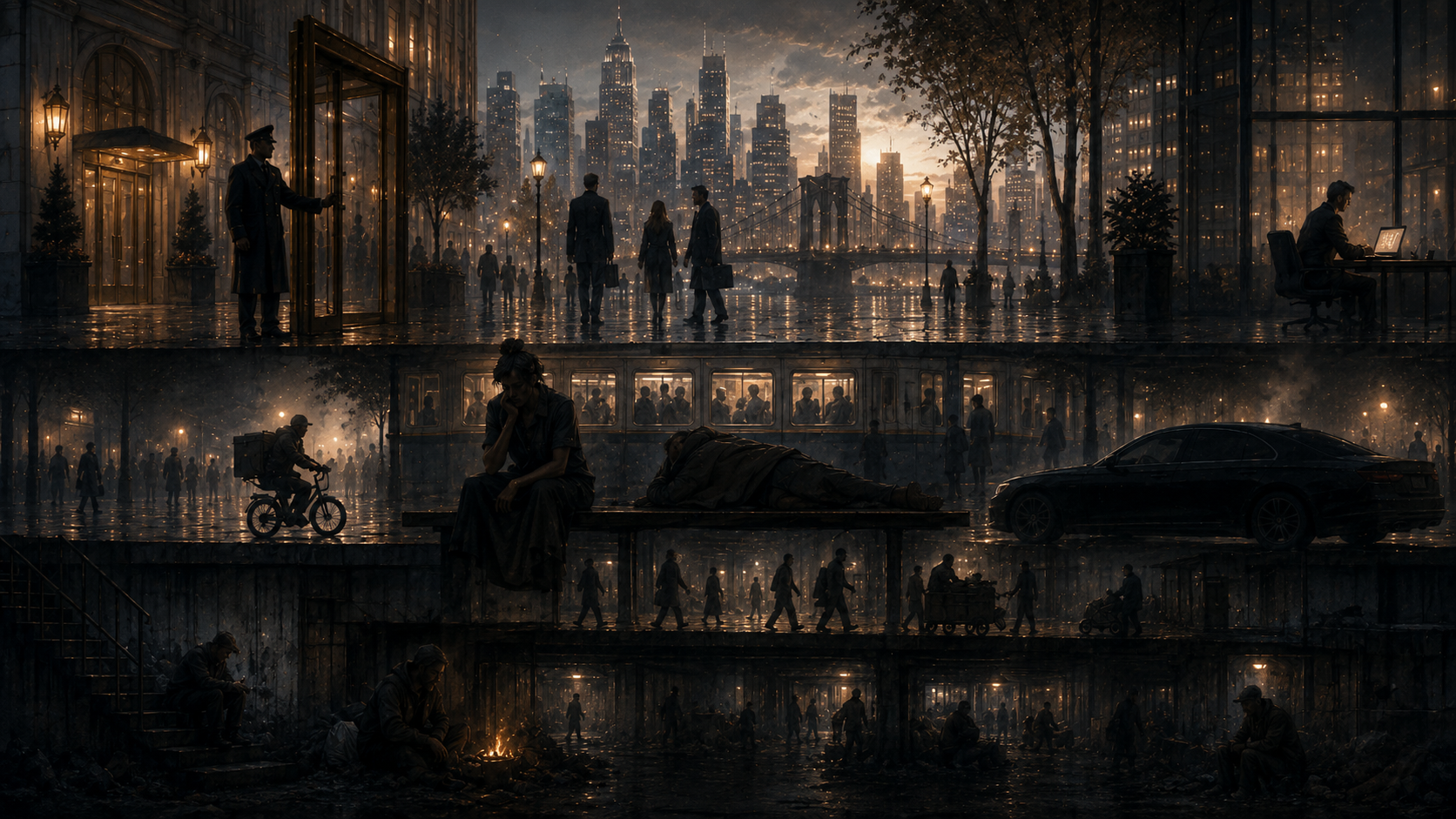
What is peculiar here is not the absence of archetypes, but their permeability. The person ordering dinner on an app summons the delivery worker out into the rain and to the building where the worker at the door lets him pass beneath the analyst laboring late in the tower, whose lit windows glow above the exhausted nurse riding home beside the homeless man stretched across the seats, on the other side of the block the private-equity partner in a black car under the billionaire’s name carved into the wall, each life passing through the field of the next, cells in the same vast organism.
This is why the city resists simple moral description. It can produce excellence, beauty, discipline, ambition, and high culture; it can also normalize filth, loneliness, bureaucratic cruelty, and public surrender. It can make one feel that human beings are capable of almost anything, and that they are willing to step over almost anything.
New York is not America in miniature. It is more like America intensified: the ladder, the pit, the stage, the machine, the refuge, the market, the museum, the shelter, the tower, the train. The challenge in living here is not merely to notice the city’s suffering. Everyone notices it eventually. The challenge is to notice without becoming numb, to sympathize without excusing, and to love the city without lying about what it is.